 Largo Siding
 Pinellas Park's Exterior Climate Challenges
Homes in Pinellas Park sit in one of the more demanding exterior environments in the country. The combination of hurricane-force wind events, near-constant UV exposure, wind-driven rain, and salt-laden air off the Gulf doesn't take a season off. Every exterior surface on a house here is under some form of stress almost every day of the year, and siding takes the brunt of it because it's the largest exposed surface on the home.
UV breaks down pigments and surface coatings over time, which is why paint on wood or poorly finished siding fades and chalks faster in Central Florida than it would in a milder climate. Wind-driven rain finds every gap, seam, and fastener point, pushing moisture into places it was never meant to reach. And salt air, even well inland from the immediate coastline, accelerates corrosion on fasteners and trim hardware in ways homeowners often don't notice until years later, when a problem that started small has become expensive.
None of this means a home in Pinellas Park is doomed to constant repairs. It means the exterior materials and the installation work have to be matched to the environment they're going into, rather than treated as generic building products.
Why a Local Largo-Based Crew Makes a Difference
We're based in Largo, which puts us minutes from Pinellas Park rather than dispatching a crew from across the bay or another county. That matters in a few practical ways. We see how houses in this specific part of Pinellas County actually age — which elevations take the worst weather, where wind patterns tend to concentrate damage, and how humidity and salt exposure show up on siding and trim over time.
A local crew also means faster response for estimates, inspections, and follow-up, and a contractor who's going to be around locally next year and the year after — not a storm-chasing crew that shows up after a big weather event and is gone once the insurance checks clear. We're not guessing at what Pinellas County's building requirements call for; it's work we do regularly in this market.
How Coastal Exposure Affects Different Siding Materials
Not every siding material handles this climate the same way. Some hold up well with minimal upkeep; others require more attention to keep looking and performing the way homeowners expect. Here's a general comparison of how common siding materials tend to perform under Pinellas County's combination of heat, humidity, wind, and salt air.
| Material | UV/Fade Resistance | Moisture Behavior | Wind/Impact Durability | Typical Upkeep |
|---|---|---|---|---|
| James Hardie fiber cement | Strong (factory ColorPlus finish) | Non-combustible, engineered for humid climates | Rated for high-wind zones | Low |
| Vinyl siding | Fades and can warp in prolonged heat | Can trap moisture behind panels if installed loosely | Can crack or blow off in high wind | Low, but limited repair options |
| Wood/cedar | Fades, requires refinishing | Prone to rot and insect damage in humidity | Moderate | High — regular painting/sealing |
| Primed spruce/engineered wood | Coating breaks down without upkeep | Vulnerable to swelling if edges aren't sealed | Moderate | High — moisture-sensitive |
This is a general picture, not a verdict on every product on the market — installation quality, product line, and maintenance habits all affect real-world results. But it explains why we made the decision we did about what we put on homes in this area.
Why We Install Only James Hardie Fiber Cement Siding
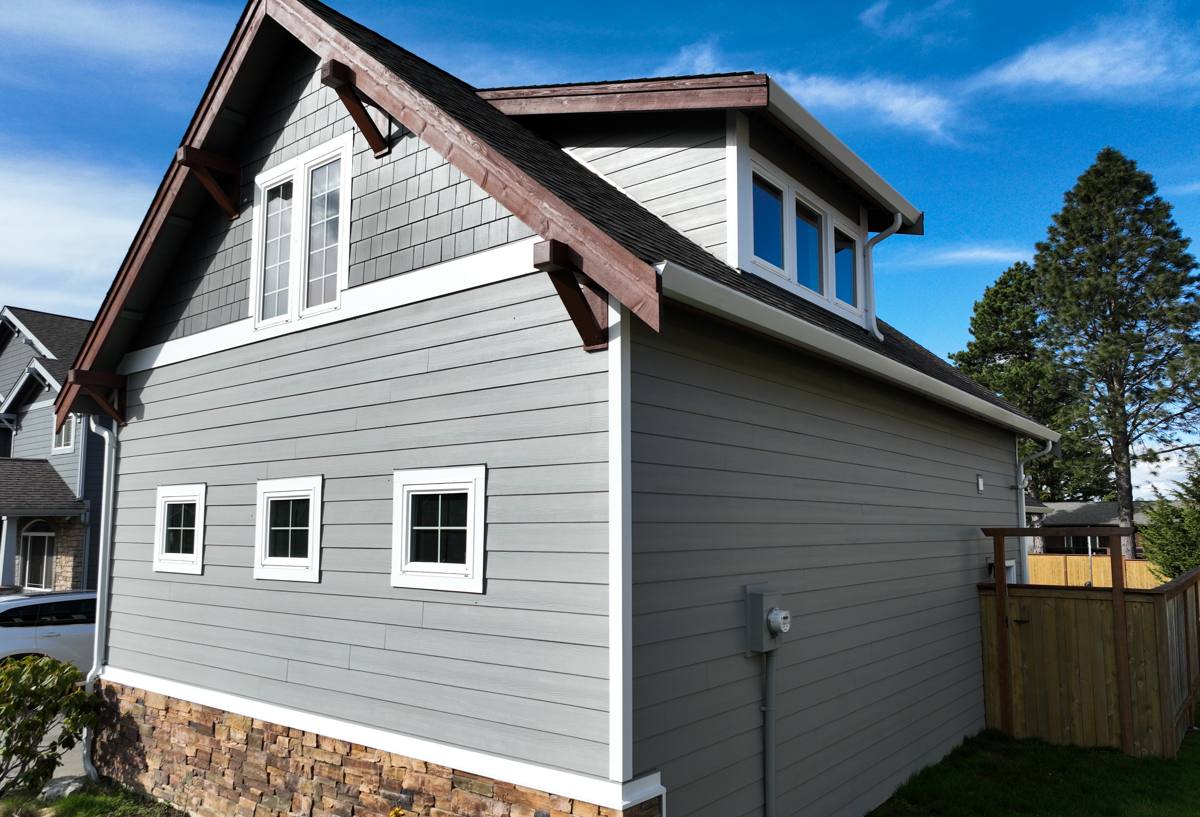
We install James Hardie fiber cement exclusively. We don't install vinyl, LP SmartSide, Cemplank, Allura, or primed wood siding — not because those products have no place in the market, but because after years of working on homes in this climate, we decided we'd rather stand fully behind one system that's engineered for exactly these conditions than offer a menu of products with different long-term trade-offs.
Fiber cement is non-combustible, which matters for insurance and peace of mind alike. It doesn't warp or soften in sustained heat the way some vinyl products can. James Hardie's HZ5 product line is specifically engineered for humid, high-moisture climates like ours — the formulation and moisture-management design account for the kind of year-round humidity and wind-driven rain exposure that Pinellas Park homes deal with. The ColorPlus factory finish is baked on under controlled conditions, which gives it more consistent fade resistance over time than field-applied paint on wood or composite substrates.
James Hardie also backs its products with a strong, transferable limited warranty — useful if you sell the home before the siding's functional life is up. None of this means other products are unusable; it means that when we're the ones doing the installing and putting our name behind the work, we want a system we've seen consistently hold up in exactly this kind of coastal, high-UV, high-wind environment.
Product Lines and Options
James Hardie's lineup includes lap siding, shingle-style siding, board-and-batten panels, and trim, available in a range of ColorPlus factory finishes as well as primed options for site painting. For Pinellas County specifically, the HZ5 climate-engineered formulation is the standard we work with, since it's built for the moisture and humidity profile of this region.
What a Professional Installation Involves
Fiber cement siding performs the way it's supposed to only when it's installed correctly, and installation quality is where a lot of the real-world difference between a siding job that lasts and one that causes problems actually comes from. Correct installation in a wind-driven-rain climate like ours involves several details that are easy to skip and hard to notice until years later:
- Proper water-resistive barrier and flashing behind the siding, not just around windows and doors but at every horizontal joint
- Correct fastener type, spacing, and penetration depth — under- or over-driven fasteners are a common cause of early failure
- Manufacturer-specified clearances from rooflines, decks, and grade to prevent moisture wicking
- Proper caulking and sealing at joints and penetrations, using products rated for this climate
- Correct panel gapping to allow for expansion without stressing seams
These aren't optional extras — they're the difference between a fiber cement installation that goes the distance in a coastal Florida climate and one that develops moisture problems within a few years despite using the same base material.
Beyond Siding: Roofing, Windows, and Decks for Pinellas Park Homes
Siding doesn't work in isolation. The roofline, window flashing, and any attached decking all interact with how water moves around a home's exterior, which is why we handle roofing, windows, and decks in addition to siding. A roof with failing flashing can send water down behind otherwise sound siding. Windows that aren't properly flashed and sealed create the same problem at a smaller scale, but repeated dozens of times around a house. And a deck attached to the house needs its ledger board and flashing detailed correctly, or it becomes a moisture entry point right at the exterior wall.
Approaching a home's exterior as one connected system, rather than a set of unrelated projects, tends to produce better long-term results than treating siding, roofing, windows, and decks as separate problems handled by separate contractors who never talk to each other.
Signs Your Siding Needs Attention
Homeowners in Pinellas Park don't need to wait for visible damage to start paying attention to their siding's condition. Some early warning signs worth a closer look:
- Peeling, bubbling, or chalking paint, especially on south- and west-facing walls
- Soft spots or visible swelling, particularly near the bottom edges or around windows
- Visible gaps, warping, or panels that have pulled away from the wall
- Persistent staining or dark streaking that doesn't wash off
- Interior signs like peeling wallpaper, musty odors, or soft drywall near exterior walls
- Fasteners that are visibly rusting or backing out of the siding
Catching these early usually means a smaller repair. Waiting means the moisture has had more time to work its way into the wall assembly behind the siding.
Maintaining Your Siding in Pinellas County's Climate
Even low-maintenance materials benefit from periodic attention in this environment. A yearly visual walk-around, rinsing off salt residue and accumulated grime, and re-caulking joints that have opened up over time all go a long way toward getting the full expected life out of a siding system. James Hardie's factory finish reduces how often repainting is needed compared to field-finished materials, but it's not a substitute for basic upkeep — it just means that upkeep is lighter and less frequent.
If you're weighing a siding replacement, a roof that's showing its age, windows that are past their useful life, or a deck that needs rebuilding, we're happy to take a look and talk through what we're seeing, with no pressure and no obligation. Reach out for a free estimate and we'll walk your property with you.